



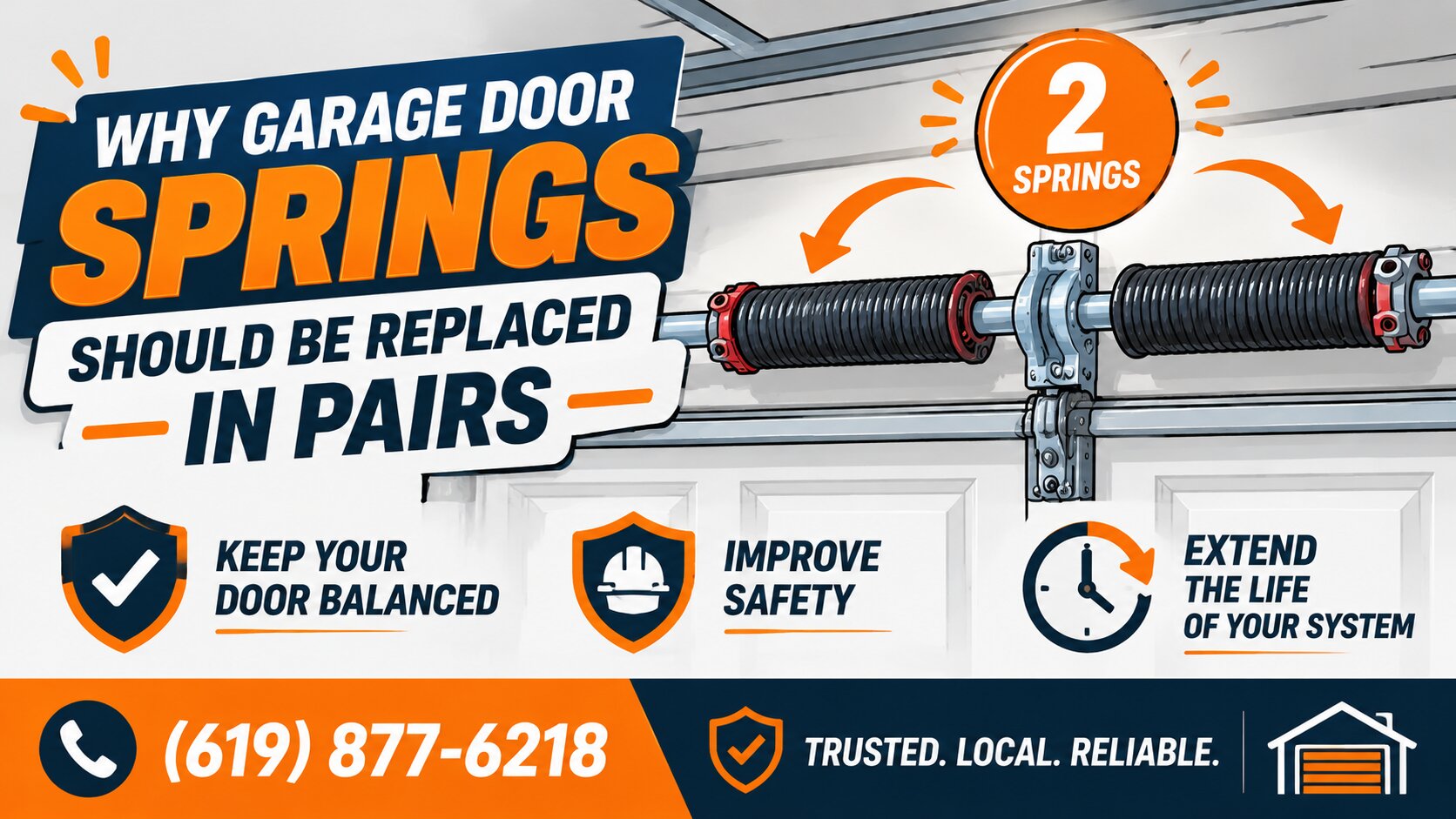
Why Replace Springs in Pairs?
If your garage door has two springs and only one has failed, it is worth understanding why a technician may recommend you replace springs in pairs rather than swap out the broken one alone. A two-spring door relies on both springs working together to lift and lower the door smoothly. When one spring is new and the other has been doing the same work all along, the two no longer share the load the way they were designed to.
What Does a Balanced Garage Door Mean?
A balanced garage door is one where the springs supply enough counterforce to offset the weight of the door panels at every point along the track. When a door is balanced, it should feel light and controlled as it moves, with the springs doing the bulk of the lifting work rather than the opener.
Balance depends on both springs contributing equally. The Garage Door Springs work as a pair, each one tensioned to match the other so the door rises and falls evenly across its full width.
When that match is broken, the door no longer behaves predictably, even if it still opens and closes.
What Happens With One New Spring and One Worn Spring?
A door with one new spring and one worn spring tends to pull unevenly as it travels along the track. The new spring is stronger and more responsive, while the worn spring has less tension left to give, so one side of the door lifts faster or with more force than the other.
This mismatch shows up as a door that tilts slightly as it moves, or that seems to lean to one side when it is partway open. Over time, that uneven pull places extra strain on the parts around the springs rather than on the springs alone.
How Does an Uneven Pair Affect the Rest of the Door?
An uneven spring pair does not stay contained to the springs themselves. The strain spreads to the cables, the opener, and the track, since all of these parts are built to work with a door that rises and falls in a level, predictable way.
You can read more about how tension travels through the lifting system in this overview of Garage Door Cables.
Will the Second Spring Fail Soon Too?
A spring that has been operating alongside one that just failed has gone through the same cycles of lifting and lowering the door. If one spring has reached the end of its tension and given out, the other spring on the same door has been carrying a very similar workload the entire time.
That does not mean the second spring is guaranteed to fail on any particular day, but it does mean it has less tension in reserve than a new spring would. Replacing only one spring leaves a mismatched pair in place now and a reasonable chance of a second failure later.
Questions to Ask a Technician
When a technician inspects a two-spring door, there are a few direct questions that can help you understand your options and what condition the system is in.
For background on the two main spring designs, see this FAQ on torsion and extension springs. If you want to understand the signs that led up to a spring failure, this post on when to replace springs covers that ground in more detail.








Leave A Comment