



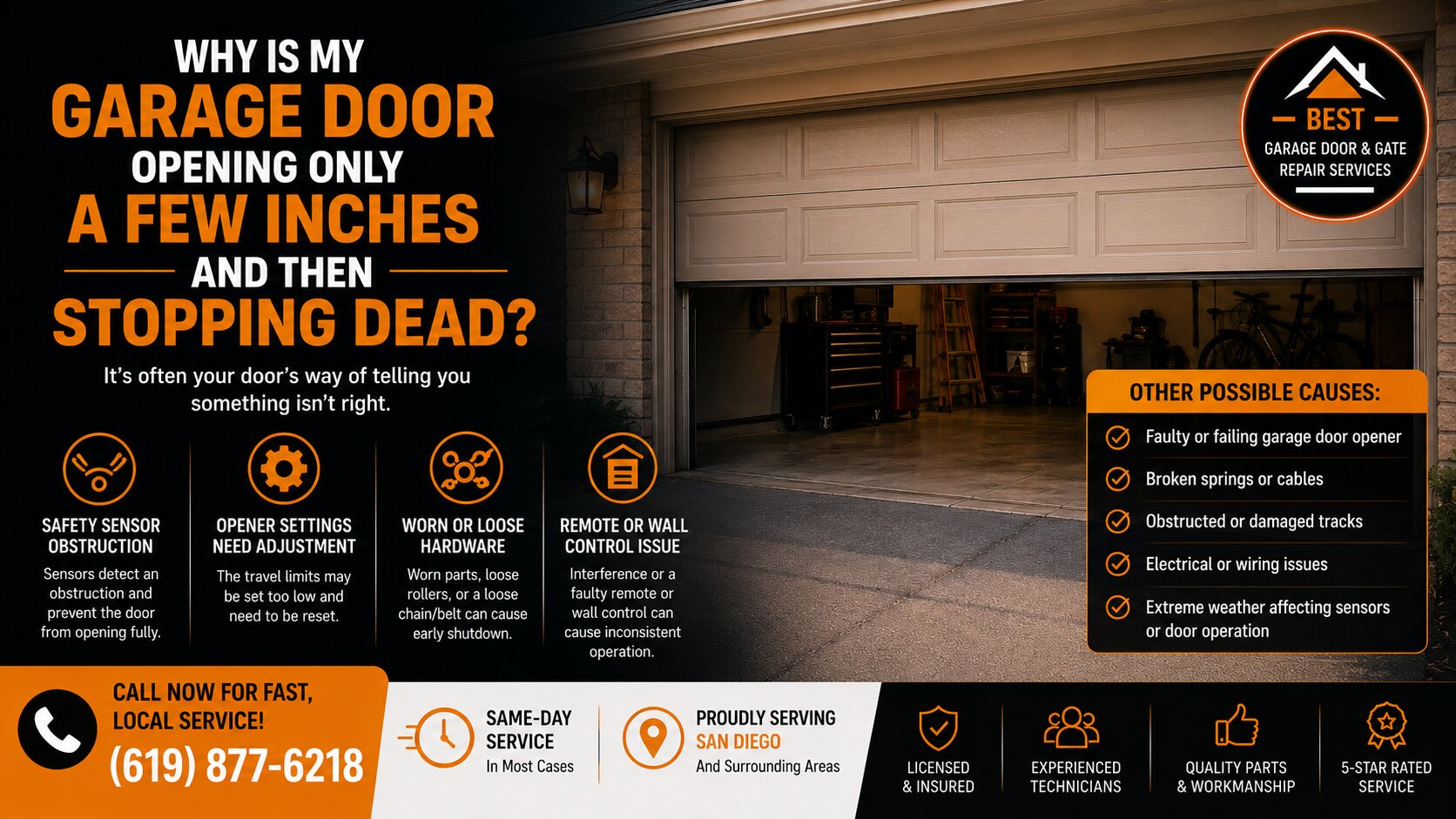
When your garage door opens only a few inches and then stops dead, you’re almost certainly dealing with one of five common issues: a broken spring, a snapped lift cable, incorrect opener limit settings, a track obstruction, or improper force sensitivity. The key is to diagnose them in the right order so you don’t waste time or risk injury.
I’ve seen this exact symptom hundreds of times across San Diego, from coastal homes in La Jolla to inland properties in Santee. The good news is that most of these problems have straightforward fixes once you identify the root cause.
Start With the Manual Lift Test
Before you do anything else, disconnect your opener by pulling the red emergency release handle. This disengages the trolley from the door so you can lift it manually.
Try to lift the door about three feet off the ground. If it feels extremely heavy or won’t budge, you likely have a broken torsion or extension spring. A properly balanced garage door should lift smoothly with minimal effort and stay in place when you let go halfway up.
If the door lifts easily by hand but still stops when the opener runs, the problem is with the opener itself, not the door hardware. This tells you exactly where to focus your troubleshooting, whether you’re dealing with a residential system or need Commercial Garage Door Repair for your business property.
Most Likely Culprits in Order
Here’s how I walk through diagnosis with my clients:
Safety First: Know When to Call a Pro
Garage doors in San Diego’s coastal areas also face added stress from salt air and humidity, which can accelerate spring fatigue and cable corrosion. Regular inspections help catch these issues before they leave you stuck, and understanding Why Hiring A Professional For Garage Door Installation Saves Money, Time, And Injury applies equally to repairs involving high-tension components.
Our team at Best Garage Door & Gate Repair Services handles these exact scenarios every day throughout San Diego. We carry all common spring sizes and cable types on our trucks, so most repairs are completed the same day. If your garage door is stopping short and you need fast, reliable service, give us a call at (619) 877-6218 and we’ll get your door back to smooth, full operation.

Leave A Comment